
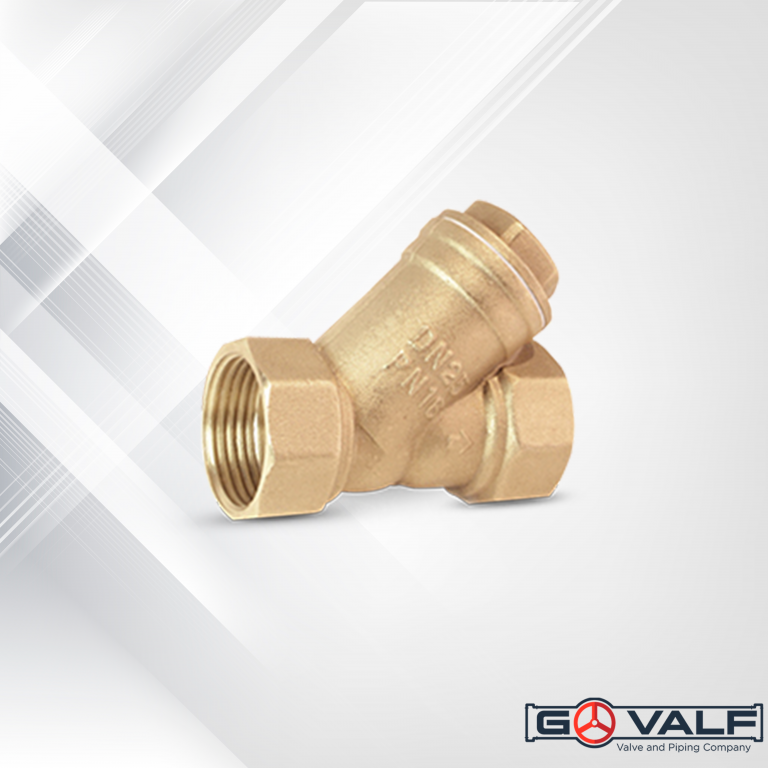
Strainer brass is equipment that allows cleaning by keeping unwanted elements in pipelines. These strainer brasses, which have filtering properties in general, also play a critical role in protecting large systems with high costs. The dirt-retaining brass, which ensures that these large systems are least affected by the harmful elements coming from the outside, also provides important conveniences in cleaning. In addition to their easy-to-assemble structures, it is possible to carry out cleaning operations easily by removing the cover positioned in the body section. Strainer brasses are designed to minimize pressure loss as much as possible. At the same time, the effects on the flow are also quite low.
What Is Strainer Brass and What Does It Do?
Strainer brass plays a critical role in protecting large systems that are costly and highly sensitive. Strainers, which can be easily mounted in the installation, provide a detailed cleaning by filtering harmful and harmful elements that may adversely affect the installation.
Strainers, which can be used in almost every installation, are made of brass material. Brass is a special material that is a mixture of copper and zinc. It is also found in brass materials, such as iron, nickel, lead and tin, which perform very important in terms of durability. Therefore, it is possible to say that brass materials have a high level of resistance and durability.
What is Strainer Brass?
Strainer brass is auxiliary equipment that protects the pipeline from harmful elements and prevents it from damaging the entire installation. Especially in high cost and sensitive installations, harmful substances coming from outside damage a large part of the installation. In order to prevent this damage and to perform cleaning in the line in the most effective way, it is recommended to use strainers.
Strainers have an important role in the protection of high-cost parts such as pumps, control valves and meters in the installation. These parts have a sensitive structure as well as high in cost. In addition, the fact that they do not have any filters causes them to be unprotected against the effects of harmful substances coming from the outside.
What Does the Strainer Brass Use?
In this direction, the strainer brass has a vital function in protecting the most critical parts of the installation. Strainers are parts that must be used in some plumbing systems. Especially in hydrophore lines, strainers should be used as mandatory to protect the entire installation.
The most important part in booster pipe installations is the booster system. In order for the booster to be protected correctly and effectively, it must be kept away from harmful substances. Strainers take over the task of protecting the booster here. The assembly process of the brass strainers is also quite simple. The most basic point to be considered in the assembly of this part, which is easily adapted into the installation, is the positioning of the filter cover as below.
Where Is Strainer Brass Used?
Strainer brass is widely preferred especially in installations where sensitivity is intense. These installations can be condensers, turbines, pumps, nozzles or similar type systems. In addition to all these systems, brass strainers are also a widely preferred part in residential and industrial installation applications.
The usage areas of brass strainers can be listed as follows:
Brass strainers are suitable for use in installations in the temperature range of -10 degrees to +90 degrees.
PRODUCTION STANDARDS
DN15→ DN50
PN 16
Connection Thread EN ISO 228-1
Face to Face Dimensions EN 331
Tests EN 12266-1
Marking EN 19
FEATURES
It provides protection from particles to sensitive and costly installation equipment.
By removing the cover placed on the body, detailed cleaning can be done or the filter can be changed.
It has been designed to have a minimum effect on pressure loss and flow rate.
Pipe thread length should be shorter than the thread length on the body.
Pay attention to the flow direction on the body.
Installation should be done with the filter cover facing down.
hot and cold water
oils
Heating Cooling
Residential and industrial applications
Compressed air installations
HEAT
-10, +90 °C


